Four Grafting Robots, One Production Line: How to Plan Labor and Output
A grafting robot production line should be planned around the people and seedlings moving through it, not just the number of machines. Four robots may provide enough nominal grafting capacity for an order book, yet still spend time waiting for prepared plants or a clear collection area.
For the AiGRAFT four-station arrangement discussed here, the starting configuration is eight people feeding rootstock and scion, plus one person collecting and arranging finished seedlings into trays. That is nine direct line positions, not the total nursery workforce. Preparation, transport, quality checks, cleaning, break cover and healing management still need to be assigned. The shared collection role must be validated at the required output.
The practical question is whether connecting the stations lets your team move more acceptable plants through the whole process with fewer repeated handling tasks.
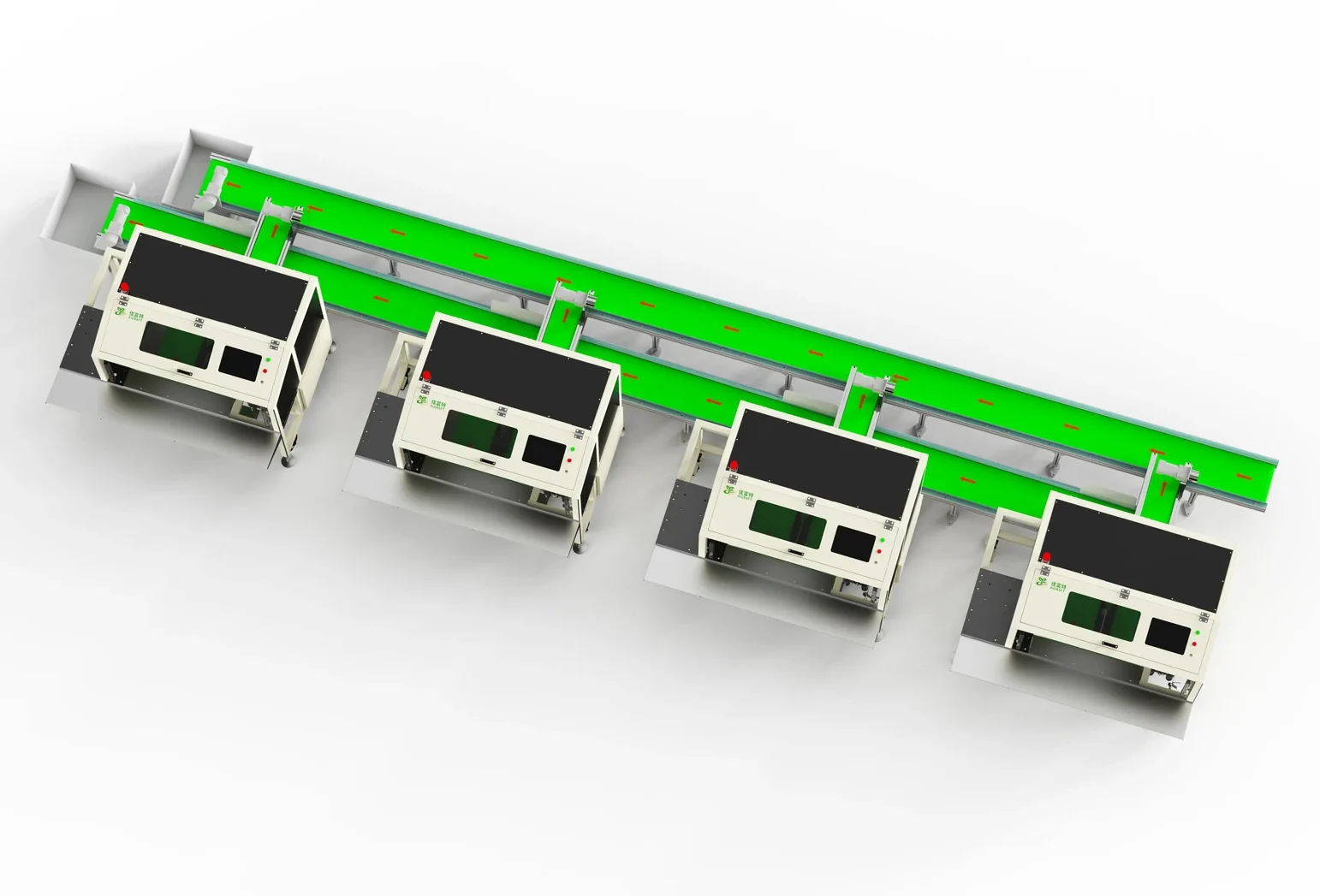
AiGRAFT product-line illustration. The final station layout and collection arrangement depend on the project.
What Changes When Four Grafting Stations Become One Line?
In a multi-robot grafting system, the stations work in parallel. A seedling is grafted at one station; it does not pass through all four robots for four separate grafting operations.
The purpose of connection is to organize common tasks: supplying prepared seedlings, moving grafted plants away from the workstations, collecting output and keeping batches identifiable. Simply placing four machines next to each other does not establish a balanced production line.
AiGRAFT lists a nominal rating of 1,200 seedlings per hour for each JFT-B1200TA. Four stations therefore have a combined nominal rating of 4,800 seedlings per hour, as shown in the integrated grafting production line configurations. This is a machine-capacity calculation, not a promise of hourly or shift output.
Four standalone machines with the same rating have the same nominal sum. The reason to connect them is better organization of the surrounding work, not an automatic increase in each machine’s speed.
How Many People Should You Plan For?
Compare labor using the same operating boundary. The table below assumes that each standalone workstation has a dedicated collection operator. A nursery that already shares collection staff will have a different baseline.
| Direct operating role | Four standalone stations, dedicated collection | Four linked stations, shared collection arrangement |
|---|---|---|
| Rootstock feeding | 4 | 4 |
| Scion feeding | 4 | 4 |
| Collection and tray arrangement | 4 | 1, subject to line trial |
| Total direct line positions | 12 | 9 |
| Preparation, transport, cleaning, quality and relief | Additional | Additional |
In this defined comparison, three collection positions are consolidated. The eight feeding positions remain. It would be misleading to turn that difference into a whole-nursery labor-saving percentage without measuring the other work.
These are operator-fed semi-automatic seedling grafting robots, not an unattended system. Give each additional task an owner: who brings the next rootstock batch, replaces empty trays, removes waste, checks labels and covers breaks? A staffing chart is incomplete when those jobs are assigned only to “whoever is available.”
Can One Collector Keep Up With Four Robots?
This is the first point to test in a demonstration. At the combined nominal rating, the line produces an average of 80 grafted seedlings per minute, or one every 0.75 seconds. Those figures describe the combined arrival rate; they do not establish that one person can manually place every plant into a tray at that pace.
Ask the supplier to demonstrate the proposed collection method with your trays and seedlings. Observe whether the person handles individual plants, groups of plants or already organized output. Do not assume automated tray loading is included because a conveyor is present.
Time the whole task, including empty-tray replacement, filled-tray movement, rejected plants and identification labels. Also watch for uneven arrivals when several stations discharge together. An average rate can hide short bursts that overwhelm the collection point.
If output accumulates, reassess collection equipment, buffer capacity, line speed or staffing. Do not preserve a nine-position claim by quietly transferring the extra work to uncounted support staff.
Calculate Shift Output, Then Accepted Plants
Keep three numbers separate: rated capacity, completed grafts and plants accepted after healing. A machine counter is useful, but it does not show how many plants will meet the nursery’s delivery specification.
Use this planning method:
Completed grafts per shift = measured average running rate x productive running hours.
Accepted plants from that cohort = completed grafts x the cohort’s final acceptance proportion.
Define acceptance before the trial, including when it is assessed and what makes a plant saleable. If the measured rate already includes rejects, do not deduct the same rejects again.
The following is an illustrative calculation only, not a performance forecast or an AiGRAFT trial result:
| Planning input or result | Assumed example |
|---|---|
| Paid shift length | 8 hours |
| Productive running time after stops and changeovers | 6 hours |
| Average combined running rate | 4,000 completed grafts/hour |
| Completed grafts during the shift | 24,000 |
| Hypothetical final cohort acceptance | 95% |
| Plants later accepted from that cohort | 22,800 |
The 95% assumption is not an expected survival rate. The accepted plants are assessed later, after the agreed healing and quality checks; they are not ready for dispatch at the end of the grafting shift.
If you instead measure average output over the entire paid shift, multiply by paid hours. Do not subtract downtime twice.
Put Labor on the Same Basis
In that example, nine line positions paid for eight hours represent 72 direct line labor-hours. Dividing by 22,800 accepted plants gives approximately 3.16 direct line labor-hours per 1,000 accepted plants.
That figure excludes preparation, supervision, logistics, relief and healing work. Include those hours before comparing total labor cost with your current process. For a longer observation period, match all recorded labor to the same production cohorts.
Design the Handovers Before Placing the Machines
Supply Prepared Rootstock and Scion
Each station needs the correct plant material at the right time. Plan staging space for identified batches and a replenishment route that does not repeatedly pull feeding operators away from their positions.
For multi-variety production, decide where batch changes occur and who confirms the rootstock-scion combination. Keep labels associated with trays throughout the process. A shared conveyor must not make different customer orders harder to distinguish.
Keep Collection and Transport Separate in the Plan
Draw the route from each station to collection, then from collection to healing. Show where empty trays arrive, filled trays wait and waste leaves. Count those movements during the trial rather than treating them as negligible.
Ask how the controls respond when collection stops or one station needs attention. Can other stations continue under the approved operating procedure? What prevents seedlings accumulating at a transfer point? These are design questions, not capabilities to assume from the phrase “integrated production line.”
Confirm Healing Space Is Available
The line should not release more newly grafted plants than the next stage can receive. Purdue Extension’s tomato grafting guidance recommends working close to the healing area and avoiding drying of cut surfaces. The relevant planning lesson is to keep the handover short and controlled; the guidance is not an industrial line specification.
Check available tray positions against batches already occupying the healing area. Use your crop-specific healing schedule to plan releases and admissions, with allowance for delayed batches and cleaning. Grafting capacity and healing capacity must be planned together.
What to Measure in a Four-Station Line Trial
Use representative seedlings, trays and operators, not only the most uniform sample. Agree on an observation period that includes ordinary interruptions and at least a realistic batch change.
Record these items for both the existing process and proposed line:
- Completed grafts by station and across the line.
- Running time and stops, with reasons rather than one combined downtime total.
- Everyone who supports the line, including time spent replacing trays and moving plants.
- Collector task time and any backlog at the shared output point.
- Immediate rejects, their causes and subsequent handling.
- Batch identity and transfer time into healing.
- Final accepted plants from the tracked cohort at the agreed inspection stage.
This gives the purchasing team a useful comparison: how many acceptable plants the arrangement produces, how much work it requires and where additional capacity would actually help.
Questions Before Expanding the Line
Can Existing Grafting Machines Be Connected?
Possibly, but the specific machines and site must be reviewed. Confirm transfer interfaces, controls, working heights, utilities and the operating procedure before treating existing units as compatible.
Can the Same Line Handle Tomatoes and Watermelons?
Do not assume the same grafting setup suits both. Crop structure, grafting method and seedling condition need separate evaluation. Discuss compatible station configurations and whether crop changes affect shared handling equipment.
Can Different Varieties Run at the Same Time?
That depends on the validated machine settings and how batches remain identifiable through shared collection. Small, mixed orders may need a different schedule from a long run of one rootstock-scion combination.
Should a Nursery Install All Four Stations at Once?
Base the decision on recurring peak demand and the surrounding process. If collection or healing is already the bottleneck, resolve it before adding grafting capacity. Ask for a phased layout if expansion is likely, without assuming every auxiliary component can be reused unchanged.
Plan the Line Around Your Nursery
The useful comparison is not four robots versus four people. It is your current workflow versus a defined multi-station arrangement, measured using the same labor boundary and plant acceptance criteria.
Review AiGRAFT nursery automation cases for application context, then discuss a line configuration using your crop, rootstock and scion details, tray formats, daily target, current staffing, floor plan and available healing space. Include a short video of material movement around the existing workstations. That often reveals more about the next investment than the machine counter alone.